

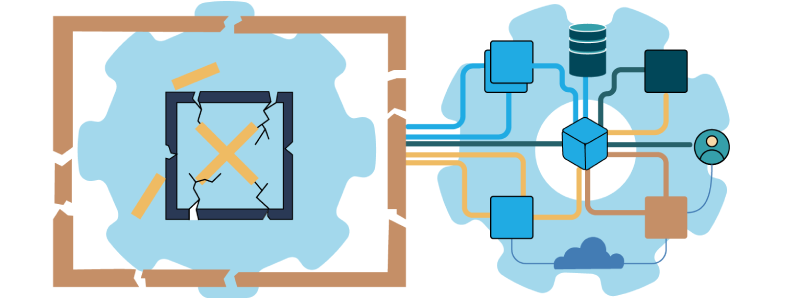
Your production incidents don't always come from your applications, but from what connects them.
1. Testing validates the application, not its scope
It's a familiar scene in many IT departments. An application has been specified, developed and tested. It passes every test. It goes live during an approved window. And the next morning, a data flow stops going through, an overnight batch has halted, a service returns an error.
So you look for the fault in the application you just deployed. You don't find it, because it isn't there. On its own, the application behaves exactly as designed. What broke is what connects it to the others.
This is the most common cause of failure in production: not what the deployment contains, but what it covers.
2. How partial deployment breaks things
An enterprise application is no longer a standalone building block. It exposes interfaces, consumes data flows, shares reference data and feeds downstream processing. Every link of this kind is an “implicit contract” between two applications: an exchange format, a data structure, an expected sequence.
But changes to these applications don't come out of the same pipeline. They come from separate development branches, handled by different teams, on different schedules. When a change alters an “interface contract”, it almost always comes with the matching change on the calling application's side, but in a separate release.
Deploying one without the other puts half a contract into production. Technically, each release is valid. Functionally, the whole is inconsistent.
This is why synchronized deployment has stopped being a best practice and become a structural constraint. It isn't a question of discipline: it's a direct consequence of growing interdependencies between applications.
3. Testing proves nothing about production
In almost every organization, developers have no access to production. They deploy to test environments; going live is another team's job, with different tools and different procedures.
That separation is healthy and it protects production. But it creates a blind spot that no one owns: an application validated in isolation during testing tells you nothing about how it will behave in synchronized production. The development team validates an application scope. The operations team executes a deployment scope. These are not the same objects, and consistency between them belongs to no one.
So the flaw is neither in the code nor in the operational procedures. It sits in the seam between the two, exactly where only IT leadership has the authority to act.
4. Dependencies: a problem of scale
Synchronization is a matter of coordination, and therefore of method. It doesn't survive contact with the numbers.
In a typical organization, there are around a hundred developers for five people in operations. At some customers, a team of fewer than ten people handles several thousand applications and several thousand deployments a month.
At that volume, the question is no longer how skilled the teams are. It's a question of workload. No team of that size can maintain by hand a dependency map covering several thousand applications, keep it up to date continuously, and work out for every window the exact scope to deploy together. This isn't a discipline problem, it's a problem of scale. And a problem of scale is solved by tooling, not by rigor.
5. When failure can't be undone
A failed deployment can usually be recovered: rollback, hotfix, another window.
Unless the window is a legal one. Some applications have to be live on a fixed date, set by the day a regulation takes effect. There is no postponement, no next window, and rollback solves nothing: reverting to the previous state is precisely what puts you out of compliance.
In that context, an incomplete deployment doesn't cost operations time. It costs compliance.
6. Where does your organization stand?
The ability to deploy in a synchronized way can be read on a maturity scale, where each step corresponds to a different deployed object:
- The script. You automate individual actions, one at a time. Orchestration stays human.
- File deployment. You can move a set of files to a target in a repeatable way.
- Application deployment. The deployed object is no longer a file but an application, with its components and its prerequisites.
- Deployment to environments. The application is deployed to a described target, not to a machine.
- Orchestration of simultaneous deployments. Several interdependent applications are deployed as a single event, with a shared rollback point.
The decisive move happens between step 3 and step 5. Below it, synchronization remains an intention carried by people. Above it, it becomes a property of the system.
7. What this means for you
Treating deployment as a technical task means accepting that the consistency of your production environment rests on the vigilance of five people. Treating it as a service continuity issue means making it something you govern, measure and tool.
That's what DROPS makes possible: deploying applications and interdependent releases as a single event, with a rollback covering the whole set, across heterogeneous platforms.
Deploy interdependent applications without disruption
DROPS orchestrates multiple applications as a single event, with rollback.
In this dedicated datasheet, you'll find:
- Synchronized deployment of applications bound by interface contracts
- Rollback across heterogeneous platforms
- Typical use cases (migration, modernization, multi-cloud, IBM i)
- The benefits for your development and operations teams

About the author
Marc Dallas
VP R&D, DROPS Business Line Manager & Chief Architect
Marc Dallas is a key figure in technological innovation at ARCAD Software, where he has been working since 1998. After serving as Product Manager and Lead Developer on the client side, he took over as Head of R&D in 2008. As VP of R&D and Chief Architect, he defines the company’s innovation strategy and ensures the architectural consistency of the entire portfolio of solutions, with a resolutely production-oriented approach to operational software. He is also responsible for the direction of DROPS and, since 2025, has been steering the company’s AI strategy.
TRIAL VERSION / DEMO
Request a trial version or a session in our sandbox!

or
