
























Article written by Michel Mouchon on October 14, 2026
On IBM i, the real limit has never been computing power. It’s the ability to push change through safely, on a shared platform where a poorly controlled modification can be costly. Here is how to bring AI agents into the DevOps pipeline without giving up the guardrails that protect production.
The constraint isn’t compute capacity. It’s change capacity.
The real bottleneck
When people talk about applying AI to DevOps, the image that comes to mind is a developer who codes faster. That isn’t the story that really matters on IBM i.
The real story begins when you move from the developer to the team, and then to the enterprise platform: that is where delivery holds or breaks. On an IBM i estate running hundreds of interconnected applications, across several countries and/or teams, the constraint has never been compute capacity. It is change capacity: how many changes can you push into production without breaking anything?
Many organizations have already taken a first step with coding assistants. It’s a good starting point: they cut the time to a first draft, explain existing code and speed up documentation. But while they optimize an individual developer’s productivity, what really slows down a production delivery stays the same: impact analysis, testing, building evidence for audit. In other words, everything that, in a regulated or high-availability environment, happens after the first draft of code.
What “losing control” really means
IBM i is not a playground for black-box automation. It is a shared, highly context-dependent environment where RPG, COBOL and CL programs and DB2 components are linked by dependencies that only a handful of experts still fully master. And that handful shrinks with every generation.
In this context, “losing control” has a very concrete meaning: an agent that modifies code with no traceable justification; a change that lands in a test environment without anyone being able to say why; overly broad access granted for convenience; a segregation of duties that disappears because the same agent both proposes and executes.
None of this is inevitable with AI itself. It is a direct consequence of the way AI is brought into the pipeline.
An agent that builds the case, not one that decides
The good news is that this problem isn’t new: it’s the problem of any high-privilege automation. The answer isn’t to remove controls to go faster, but to make them repeatable, visible and quick to run. In practice, for an IBM i change request, the flow looks like this:
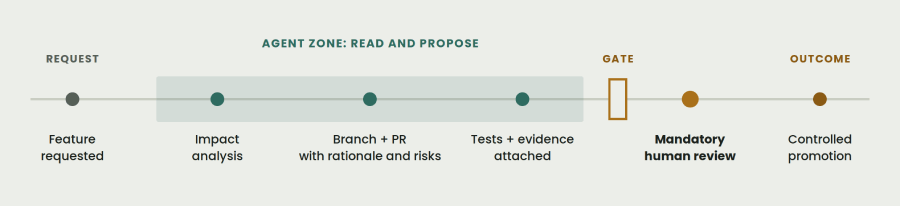
The agent builds the case (analysis, proposal, evidence) but never goes through the gate alone. Human review remains the mandatory checkpoint before any promotion to a higher environment.
The key point is not to remove controls, but to make them systematic: every step the agent produces is logged, every pull request carries its rationale and its risks, and promotion remains a human decision, backed by evidence that has already been gathered rather than reconstructed in a rush.
A maturity path, not a leap of faith
Because the IBM i environment is shared, adoption can’t be a gamble. It moves forward in stages, each one validated before moving on to the next.

Read
Dependency mapping, documentation, test recommendations. Almost no risk, immediate value: it’s the training ground for trust.
Recommend
The agent drafts a pull request but never merges it. The decision to merge stays human, every time.
Write with guardrails
Once trust is established, the agent can write in development or test, always behind pull requests and mandatory approvals.
Scope expansion always comes with stricter release gates, never the other way around. This progression delivers value early, without betting on the operational discipline that protects production.
Five non-negotiable guardrails
Once the path is set, governance itself must be designed like that of any high-privilege automation, not as a box to tick after the fact.
- Identities and least privilege. Each agent, whether it acts on behalf of a human or autonomously, has its own identity and only the rights its task requires.
- Human in the loop. Approvals and reviews remain mandatory, and this requirement is technically enforced in the pipeline: branch protections, control gates that cannot be bypassed.
- Whitelist of MCP servers and tools. The Model Context Protocol connects agents to tools: it must be governed like any interface, by defining precisely what an agent can access, nothing more.
- Systematic logging. Every tool or agent invocation is recorded, for audit as well as incident response.
- A formalized AI governance model. Beyond technical controls, the organization must have settled who decides, who approves, and how far the authorized scope extends.
In an agentic SDLC, governance isn’t a tax on speed. It’s what makes speed possible.
How ARCAD builds this control into its architecture
This is the principle that structures the ARCAD agentic platform: the agent reasons and plans, but a workflow engine, deterministic and logged, does the executing. No model improvisation on a sensitive action.
The architecture rests on three pillars. Knowledge (RAG) grounds the agent’s answers in more than thirty years of ARCAD methodology rather than in the model’s probabilities alone. Tools (MCP) expose the ARCAD DevOps stack (DROPS, the Metadata Repository, Builder) in a standardized form: around 80 DROPS REST endpoints are exposed as MCP tools, available to any MCP client, whether it’s the ARCAD agent, Copilot or Claude. Action (the workflow engine) runs ARCAD’s standard processes in a repeatable, auditable way, with sensitive steps still subject to human validation, exactly as today.
This choice has a deliberate corollary: AI is the assistant, not the engine. Results remain deterministic, not a probabilistic estimate. The source of truth remains the ARCAD repository rather than a model’s answer, and there is no runaway correction loop where the AI would endlessly try to fix its own output. Each organization chooses the steps where AI steps in; the product keeps working without it, and the cost, in tokens as well as in risk, remains predictable.
What this looks like in practice
This kind of discipline holds up at scale. At Leumit Health Services, ARCAD Transformer Field automated a field expansion project across the entire IBM i application estate, as part of an end-to-end DevOps process.
14,000
program sources scoped
2,500
sources automatically modified
1 night
overnight cutover, zero rollback
“The item code expansion project here at Leumit was beyond critical. We could not afford to go wrong.”
Aviv Rosenwasser, Head of IBM i Development, Leumit Health Services
Where to start: a 90-day plan
The adoption that works follows a simple principle: start small, govern from day one, scale what works.
Weeks 1–4
One or two strictly read-only pilots, chosen for the pain points they remove right away: impact analysis, documentation, evidence gathering.
Weeks 4–8
Guardrails go in place in parallel: identities, control gates, evidence archiving, a tool whitelist with detailed logging.
Weeks 8–12
Forming mixed squads of IBM i and non-IBM i engineers, to widen the scope without concentrating risk on a handful of experts.
Ongoing
Blameless post-mortems and shared playbooks, so that every incident avoided benefits the next team.
The goal isn’t to put AI everywhere. It’s to change faster, without ever changing blind.
ARCAD Software – Content based on real-world experience and technical sessions from the ARCAD Summit.
About the author

Michel Mouchon
CTO & DevOps Business Line Manager
CTO of ARCAD Software since 2000 and now Business Line Manager of the DevOps for Legacy brand, Michel Mouchon is responsible for defining ARCAD’s overall technology strategy. A pioneer in areas such as DevSecOps and digital transformation, he drives innovation to support the company’s growth. In this role, he plays a key part in coordinating the R&D, Engineering, and Pre-Sales departments.
Michel has developed broad, cross-disciplinary expertise in IT, beginning his career with a dual degree in Electronics and Software Engineering. His constant curiosity for emerging technologies — and how to apply them within the ARCAD and DevOps ecosystem — combined with his strong communication skills, has helped strengthen the ARCAD user community. He has also played a decisive role in highlighting new technologies, including today’s advancements that leverage AI to transform access to products and application knowledge, while maximizing the added value of ARCAD solutions.

REQUEST A DEMO
Let’s talk about your project!
Speak with an expert